How to Identify Operational Bottlenecks Before They Hurt Growth
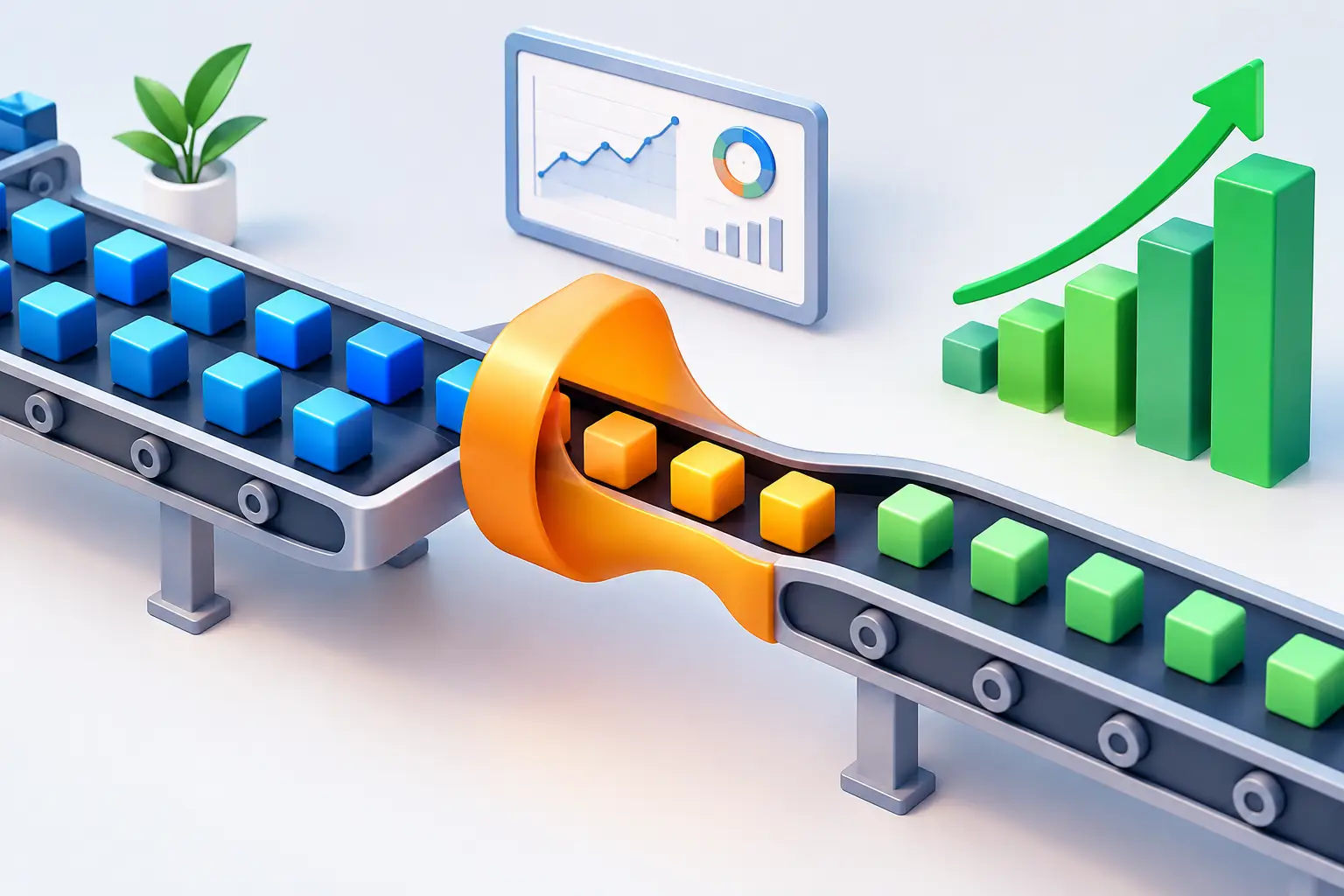
A customer waiting for a quote, a lead that didn't get a timely response, or a task stuck with a single employee isn't necessarily a staffing problem. Often it's a sign of a process that wasn't designed for load, change, or growth. To understand how to identify operational bottlenecks, you need to stop looking only at task lists and start tracking the flow of work end to end.
A bottleneck is the point where the rate of incoming work is higher than the rate of handling or approval. The result is not just an isolated delay. It creates accumulation, duplicate work, uncertainty for customers, decisions made too late, and team burnout. In a small business, the problem can hide with the business owner. In a growing company, it may show up in the handoff between sales and operations, in quote approvals, in data collection, or in report generation.
Why Bottlenecks Are Hidden from View
The most obvious sign of a bottleneck is not always lateness. Sometimes the team meets its deadlines, but only through manual reminders, private messages, overtime, and knowledge that sits with one person. From the outside, everything looks like it's working. In practice, the process depends on extraordinary effort that can't be scaled over time.
There is also a common confusion between temporary load and a structural problem. Load after a successful campaign, a new hire, or the end of a quarter is not necessarily an operational failure. But if the same stage is delayed again and again, if employees bypass the system in order to "move things forward," or if the customer has to ask what's going on instead of receiving a proactive update, this is a pattern that requires attention.
The difficulty grows when information is scattered across spreadsheets, mailboxes, messaging systems, and personal documents. When there is no single reliable status for every inquiry, quote, or task, it's easy to blame people instead of identifying the real point of friction.
How to Identify Operational Bottlenecks Systematically
Effective detection starts with mapping one process that has a clear business impact. There's no need to map the entire company in a single day. It's better to choose a path where the delay is felt directly in revenue, service, or costs: handling a lead, preparing a quote, onboarding a new customer, approving an invoice, or closing a service ticket.
Define a Starting Point and a Final Outcome
Write down what triggers the process and what counts as its completion. For example, in a sales process the starting point is a new lead, and the end can be a signed quote, a closed deal, or an orderly classification of a lead that did not progress. Between the two points there are stages, owners, data, and decisions.
It's important not to settle for a general description such as "the team handles the lead." You need to break the path down into actual actions: capturing details, checking fit, making contact, scheduling a meeting, preparing a proposal, approving exceptions, and follow-up. The more the mapping is based on what actually happens rather than on a theoretical procedure, the more useful it will be.
Measure Wait Time, Not Just Execution Time
In most cases, the work itself is relatively short. A rep can enter data within minutes, and a manager can approve a quote in a short time. What delays the process is the wait time between stages: the task that wasn't assigned, the document waiting for review, or the customer who didn't receive a reminder.
Therefore, for each stage it's worth measuring two data points: how long it takes to perform the action, and how long the item waited before the action began. If preparing a quote takes twenty minutes but it waits three days for approval, the point of friction is not necessarily the sales department. The approval may depend on one person, the criteria may be unclear, or requests may not arrive in an orderly queue.
Look for Accumulation and Rework
A bottleneck creates a queue. So it's worth checking where the most open items accumulate, which status remains without movement, and how many times additional information is required before progress is possible. Accumulation is not always visible on a task board. Sometimes it appears as repeated messages, files with different versions, or customers who reach out again.
Rework is an especially important metric. If quotes keep coming back for correction, forms arrive incomplete, or the service team repeatedly asks for details that were already provided, the problem may lie in the collection stage and not in the stage where the error is detected. Automating a flawed stage will only speed up the passing of errors downstream.
Compare the Official Process to the Real One
Every organization has a process that appears in a document and a process that happens in practice. The gap between them reveals a lot. Ask employees how they know a task has reached them, what they do when information is missing, whom they turn to for approval, and where they document an exception.
If the answer is "we send the manager a message," "we check in the group," or "I just remember," this is an unmanaged dependency. This is not a criticism of the employees. Most of the time they created shortcuts in order to meet requirements. Management's role is to turn the shortcut into an orderly mechanism, or to eliminate the need for it.
The Metrics That Separate Feeling from Fact
Not every delay deserves a systems project. To set priorities, examine the impact of each bottleneck on four dimensions:
- Cycle time - how much time passes from the moment a request is opened until it is closed.
- Scale of accumulation - how many items are waiting at each stage and for how long.
- Business impact - delayed revenue, leads that go cold, customers who churn, or rising service costs.
- Operational dependency - how much the process relies on a single person, file, or communication channel.
A single metric alone can be misleading. A slow stage that doesn't affect a customer or revenue can wait. On the other hand, a small delay in responding to a hot lead can significantly hurt the conversion rate. Priorities should be based on the combination of frequency, cost, and impact, not just on who complains the loudest.
What to Do After You Identify the Barrier
The right response depends on the cause of the bottleneck. If information arrives incomplete, the solution may be a structured form with required fields and validation checks. If tasks fall between the cracks, you need automatic routing to a defined role owner, along with an alert when handling time is exceeded. If an approval gets stuck with a manager, you can define an approval hierarchy by amount, customer type, or risk level.
When the issue is real overload, automation alone does not replace execution capacity. You can reduce manual actions, display a transparent work queue, and prioritize requests, but a change in the division of responsibility or additional team capacity may still be required. Technology should expose the need and remove waste, not hide a shortage of resources.
In many cases, the right move is a combination of standardization and automation. You define what counts as valid information, who is responsible for each stage, what the expected service time is, and what happens when that time is exceeded. Then you connect the data to a single system that displays status, triggers alerts, and keeps history. This is the foundation for control, not just task management.
Building Oversight That Doesn't Wait for a Crisis
A one-time detection effort is not enough. Processes change when inquiry volume grows, when employees join, or when a new service is added. Therefore, you should set up an operational dashboard that regularly displays handling times, stuck items, load by role owner, and deviations from service levels.
There's no need to overload it with dozens of metrics. A manager needs to see quickly where a decision is required. If response time to leads is rising, if quotes are waiting for approval, or if customer onboarding tasks are being delayed, the system should show it before the customer feels it. At AIA, this is exactly the principle that guides the building of operational infrastructure: unifying processes, data, and alerts to enable timely action.
It's also worth scheduling a periodic review of the process with the people who carry it out. Not to look for someone to blame, but to identify new exceptions and shortcuts that have become habit. Employees close to the work usually know where the system creates friction, as long as they are asked about facts and not only about feelings.
A bottleneck is not a failure of the business. It is valuable management information: it shows where growth meets a process that wasn't adapted to it. When you measure waiting, accumulation, and dependency instead of settling for a general feeling of overload, you can release work forward and build a capability that holds up even as the business grows.