Responding to a Lead Within Minutes: Why It Multiplies Closed Deals and How to Automate It
In short: The chance of reaching a conversation with a lead drops sharply with every hour that passes from the moment they reach out. The solution isn't "trying to respond fast" but a system: every lead lands in one place, receives a first message within a minute, and is assigned to a rep with a task and a reminder.
A lead who leaves their details is at peak interest at that moment. In most cases they left their details with competitors too — and the first one to get back to them gets the conversation. After a few hours, they're already busy with something else, and sometimes they don't remember who they contacted.
What the Research Says About Response Time
A well-known study published in Harvard Business Review in 2011 ("The Short Life of Online Sales Leads") examined the response times of thousands of companies to online leads. The key finding: companies that tried to make contact within an hour were about seven times more likely to have a meaningful conversation with the decision-maker than companies that followed up after an hour — and far more likely than those that followed up after a day. The same study found that the companies' average response time was longer than a day.
The exact numbers vary between industries, but the direction is consistent: the first few minutes are the window when the lead is hottest.
Why Businesses Don't Respond Fast, Even When They Want To
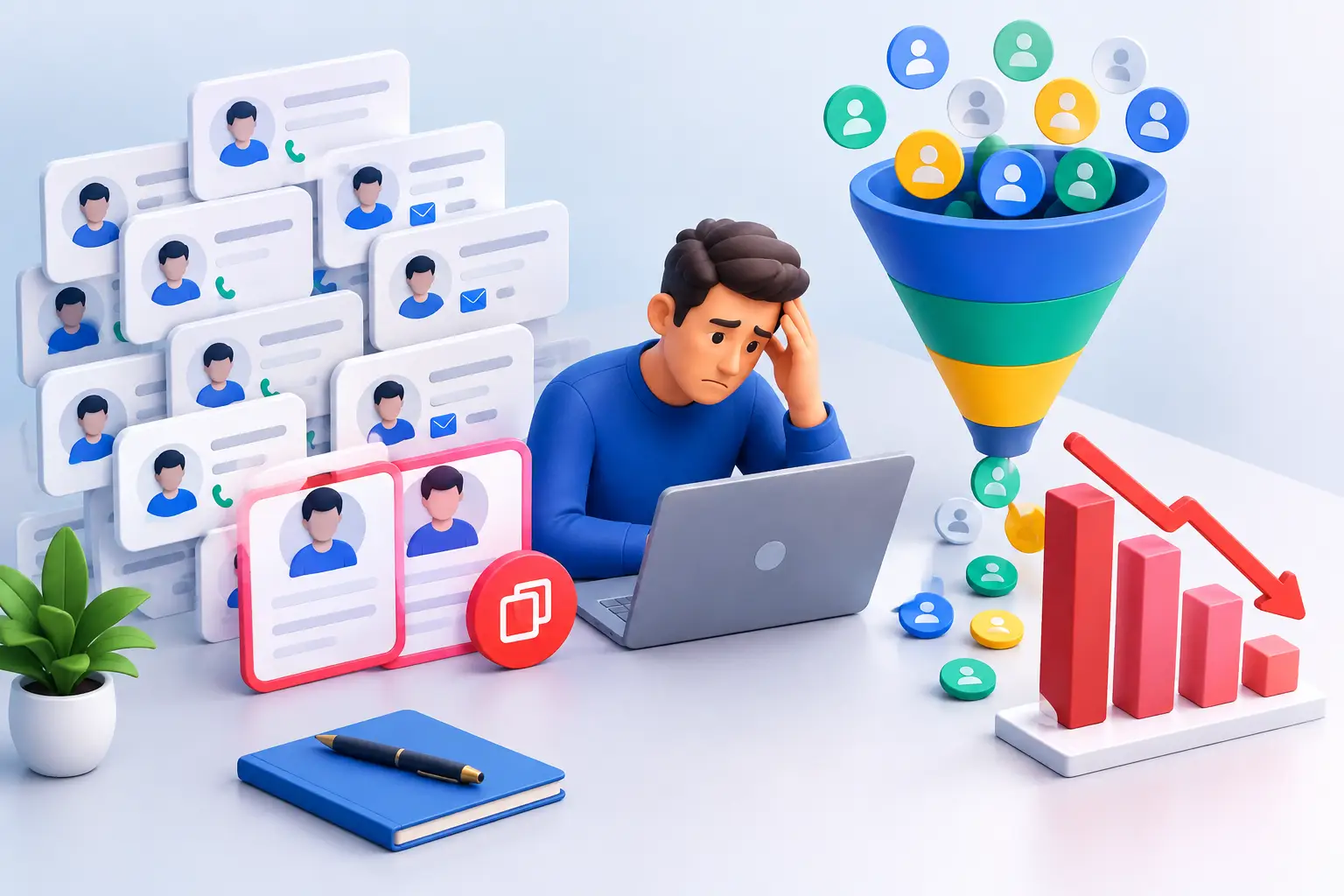
- Leads are scattered — Facebook forms, the website, WhatsApp, email. No one sees everything.
- No owner — everyone assumes someone else will follow up.
- Working hours — many leads arrive in the evening and on weekends.
- Reps are busy — in meetings, on calls, in the field.
How to Measure Lead Response Time
First response time = the time between the moment the lead comes in and the first outreach to them (a message or a call). To measure it, both moments must be recorded automatically in the CRM. Metrics worth tracking:
| Metric | What it shows |
|---|---|
| First response time (median) | How fast a typical lead gets a response |
| % of leads answered within 5 minutes | How many leads are caught while they're hot |
| % of leads not answered at all | How much money is left on the table |
| Response time by source and hour | Where and when the gap is largest |
How to Respond to Every Lead Within a Minute — Automatically
- Centralize all sources — every form, campaign, and inquiry goes into one CRM, with the source recorded.
- Send an immediate first message — a personal WhatsApp message in the business's name, offering to schedule a call or asking a qualifying question.
- Assign to a rep — by region, field, or queue, with a notification and a follow-up task.
- Schedule follow-ups — if the customer didn't respond, a follow-up message; if the rep didn't get back, a reminder.
- Measure — a weekly report of response times and unhandled leads.
The first message doesn't replace the rep — it keeps the lead warm until the rep is available. And if you want to go a step further, an AI bot on WhatsApp can also qualify leads and schedule a meeting. We build the entire system as part of an automated lead management system.
An Ordinary Day — With and Without a Response System
Without
A lead comes in from a Facebook form at 9:40 PM. At 8:30 AM someone downloads the leads to Excel. At 11:00 a rep calls — no answer. At 3:00 PM they try again, and the customer says they've already booked a meeting with someone else.
With
At 9:40 PM the lead enters the CRM. At 9:41 they receive a WhatsApp message: "Hi Dana, thanks for reaching out! We'd be happy to get back to you tomorrow morning — what works for you, 9:00 or 12:00?" Dana replies "9:00." In the morning the rep sees a task with the time Dana chose, and calls on time — while she's waiting for the call.
How to Write a Good First Response Message
A good message is short, personal, and ends with a simple question. Three sample templates:
- Scheduling a time: "Hi [Name], thanks for contacting [Business]! We'd be happy to get back to you — what works best, this afternoon or tomorrow morning?"
- Qualifying question: "Hi [Name], we received your inquiry. So we can get back to you with an accurate answer — is this for a purchase or a rental?"
- Outside business hours: "Hi [Name], thanks! We're back tomorrow at 9:00. If you'd like, write here in one line what matters most to you — so we can get back to you prepared."
What not to do: a long message with the entire price list, a link to the website instead of an answer, or "a rep will get back to you soon" — with no next step.
Leads at Night, on Shabbat, and on Holidays
An automatic first message is almost always better than silence. But if many of your customers observe Shabbat, you can configure messages that arrive on Shabbat and holidays to be answered after Shabbat ends, and the phone call to be scheduled for the following morning. The point is that the customer gets a first response before the competitor — at a time that suits them.
A Simple Test: How Fast Do You Respond Today?
- Leave your details in your own business's form — from a number the team doesn't recognize — at 8:00 PM.
- Do the same through a Facebook ad and through WhatsApp.
- Record when you received a first response in each channel, if at all.
Most businesses that take this test are surprised by the result — and get a baseline number to measure improvement against.
Frequently Asked Questions
What counts as a good lead response time?
A first message within minutes, and a human conversation on the same business day. When the first message is automatic, "within a minute" is possible even at night.
Won't an automatic message seem robotic?
Not if it's written well: in the business's name, with the customer's name, and with a clear next step ("When is a good time for us to get back to you?"). It feels much less robotic than waiting two days.
Do I need a CRM to get started?
Not necessarily. You can start with an organized spreadsheet that leads flow into automatically, and move to a CRM as volume grows.
What if I have only one rep?
That's exactly when the system matters most: it responds while you're in a meeting, reminds you to follow up, and shows at the end of the week which leads are still waiting.
How many times should I try to contact a lead who isn't responding?
There's no magic number, but most businesses give up too early. A sequence of several attempts across different channels (WhatsApp, phone, email) over a few days — stopping when the customer asks — brings back many leads that looked lost.
Should I call or send a WhatsApp message?
In Israel, WhatsApp is usually the most comfortable first touch — the customer replies when it suits them. A call fits once a time has been agreed.