AI vs. Automation: What's Right for Your Business?
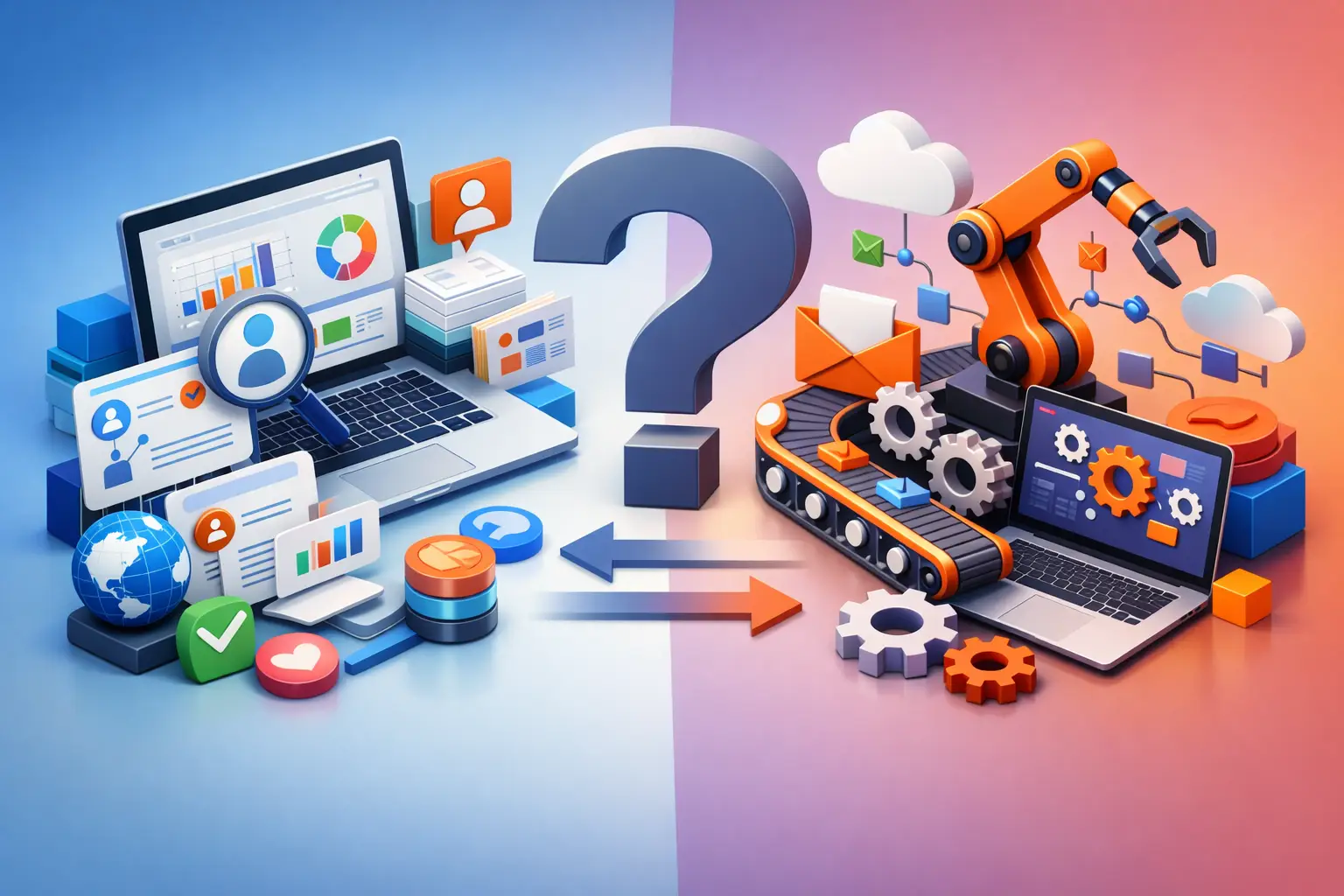
A customer submits an inquiry on the website, a salesperson receives an alert, a ticket is opened in the system, a confirmation message is sent, and a follow-up task is scheduled. This is a process that can be automated. But if you also want to identify whether the inquiry is high quality, understand which service suits it, or draft an initial response based on its context, AI comes into the picture. The distinction between AI and automation is not semantic. It determines how you build an infrastructure that reduces manual work, maintains control, and produces better decisions.
Many businesses start with a point solution: a chat tool, an email marketing system, or a connection between a form and a spreadsheet. The problem begins when the tools are not connected to a clear workflow. Lead information sits in one place, quote statuses in another, and customer conversations are managed in an inbox that no one can measure. The technology may be advanced, but without an operational structure it only adds another layer of complexity.
Automation executes a fixed process
Business automation operates according to predefined rules. When a certain event occurs, the system performs an action or a sequence of actions. If a lead fills out a form, it creates a record in the CRM. If a quote was sent and not opened for three days, it creates a reminder for the salesperson. If a customer approves a proposal, it opens tasks for the onboarding team and updates the project status.
The main advantage is consistency. The process does not depend on an employee's memory, working hours, or workload that day. Repetitive actions - transferring data, assigning tasks, status updates, alerts, and standard messages - are performed the same way every time.
Good automation is not just about saving time. It creates documentation, enables tracking, and reduces errors. When every inquiry is documented, every quote has a status, and every task is assigned to an owner, managers can identify bottlenecks before they turn into missed revenue.
That said, automation does not understand meaning. It doesn't know why a customer canceled a meeting, whether a message was written in a frustrated tone, or whether a document includes a commercial deviation. It does what it was told to do. This is an advantage when the process is stable, but a limitation when interpretation is required.
AI adds data-driven judgment
AI can analyze text, classify information, identify patterns, and suggest or generate an output based on context. For example, it can read incoming inquiries and flag which are sales inquiries, which are service requests, and which are messages that require no action. It can summarize a sales call, extract key objections, suggest a draft reply, or identify that a customer with certain characteristics is more likely to convert into a deal.
The difference is that automation asks: "If X happened, what should be done?" AI helps answer a different question: "What does X mean, and what is the most appropriate action?"
That doesn't make it the right solution for every task. When a sharp, clear rule is needed, such as sending a receipt confirmation or opening a task after payment, automation will usually be faster, more predictable, and cheaper to maintain. AI is suited to cases with high data variability, unstructured information, or a need to assess context.
An example from lead management
Suppose a company receives dozens of inquiries a week from several channels. Automation can collect all of them in one place, prevent duplicates, assign them to the right rep, and send an alert in real time. This is the foundation layer that must work without failures.
AI can add an initial score based on the content of the inquiry: whether the customer is a fit for the service, what their field of activity is, how urgent it is, and what details are missing to move the conversation forward. Then the automation can route the lead according to the score, trigger an appropriate follow-up sequence, and remind the rep when no action has been taken.
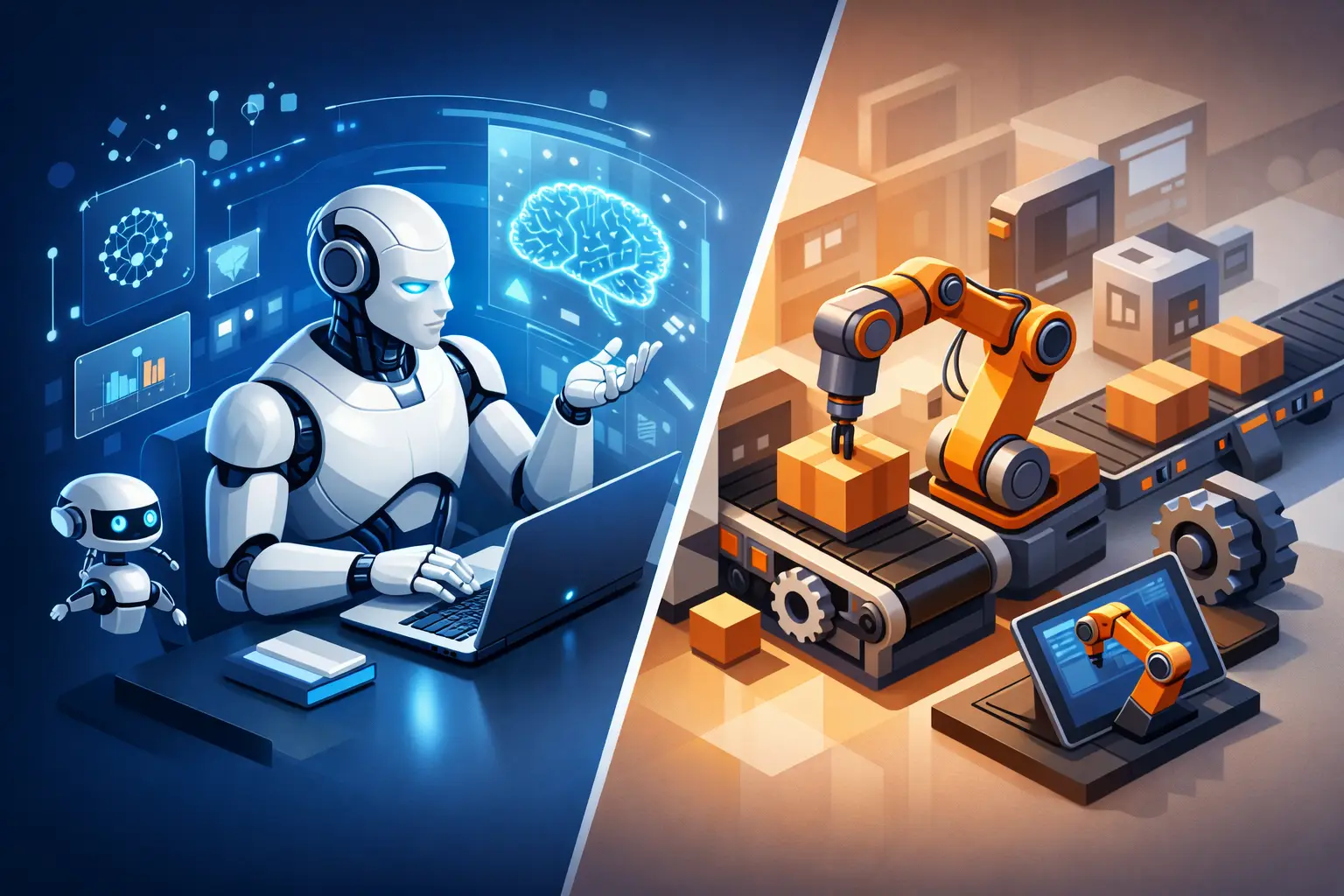
A strong system doesn't choose between the two. It uses automation to manage the flow and AI to handle information that requires understanding.
AI vs. automation: where do you start?
The common mistake is to start by choosing a tool. The right question is not "Which platform uses AI?" but "Which operational problem is costing us time, revenue, or quality control?"
It's worth starting with one process that occurs frequently and has a clear business impact. This could be lead handling, quote production, payment collection reminders, new customer onboarding, meeting summaries, or data collection for a management report. Map the starting point, all the steps in between, and the desired outcome. Then check where fixed rules exist and where interpretation is needed.
If an employee copies the same details between systems, searches for a status, sends reminders, or chases approvals - this is usually an opportunity for automation. If an employee reads large amounts of text, sorts requests, summarizes information, or drafts recurring content with adjustments - this may be an opportunity for AI.
In many cases a combination is needed. A quote, for example, can start with a structured form that feeds data into the system. Automation verifies that the essential details were received and triggers an internal approval step. AI can prepare a draft according to the type of service and the customer's needs. Before sending, a professional reviews the commercial terms. This shortens the work without giving up human accountability.
Not every process should be automated
A disorganized process doesn't become organized just because a system was connected to it. If responsibility isn't clearly defined, if sales stages vary depending on who handles them, or if customer data is incomplete, automation may accelerate confusion instead of solving it.
Before implementation, you should define ownership for each step, uniform statuses, essential data fields, and clear transition conditions. It's also important to determine what happens when the process doesn't go as expected: a customer doesn't respond, a document is missing, a payment fails, or an inquiry is misclassified. Handling exceptions is part of the design, not a late addition.
AI requires additional caution. A result that looks convincing is not necessarily correct. When it comes to a commitment to a customer, pricing, financial data, sensitive information, or a decision with material impact, human approval points should be defined. It's worth measuring accuracy over time, maintaining controlled access to information, and avoiding feeding in data that doesn't truly need to be processed.
The metric is business performance, not the number of tools
A successful project is measured by tangible operational change: shorter response time to leads, fewer forgotten quotes, a decrease in manual entry, an improved follow-up rate, or a clearer picture of the sales pipeline. Therefore, you should define a baseline metric before implementation and check it after the system is running.
For example, if the goal is to improve inquiry handling, you can measure first response time, the percentage of inquiries that received follow-up, the number of meetings scheduled, and the conversion rate to a quote. If the goal is to streamline administration, you can measure document preparation time, the number of corrections, and the time that passes between approval and execution.
Maintenance matters too. Business processes change, employees turn over, services are updated, and sales channels are added. A good system should be documented, with clear rules, appropriate alerts, and a dashboard that shows what is actually happening. AIA approaches implementation from this perspective: not another collection of connections, but an infrastructure that centralizes work, data, and management accountability.
The right step is not to buy AI because everyone is talking about it, nor to automate every action. Choose one process that burdens the team or harms follow-up, get it in order first, and then decide where a fixed rule is needed and where understanding is needed. From there you can build a system that lets the business operate faster, measure better, and maintain control even as the scale of activity grows.