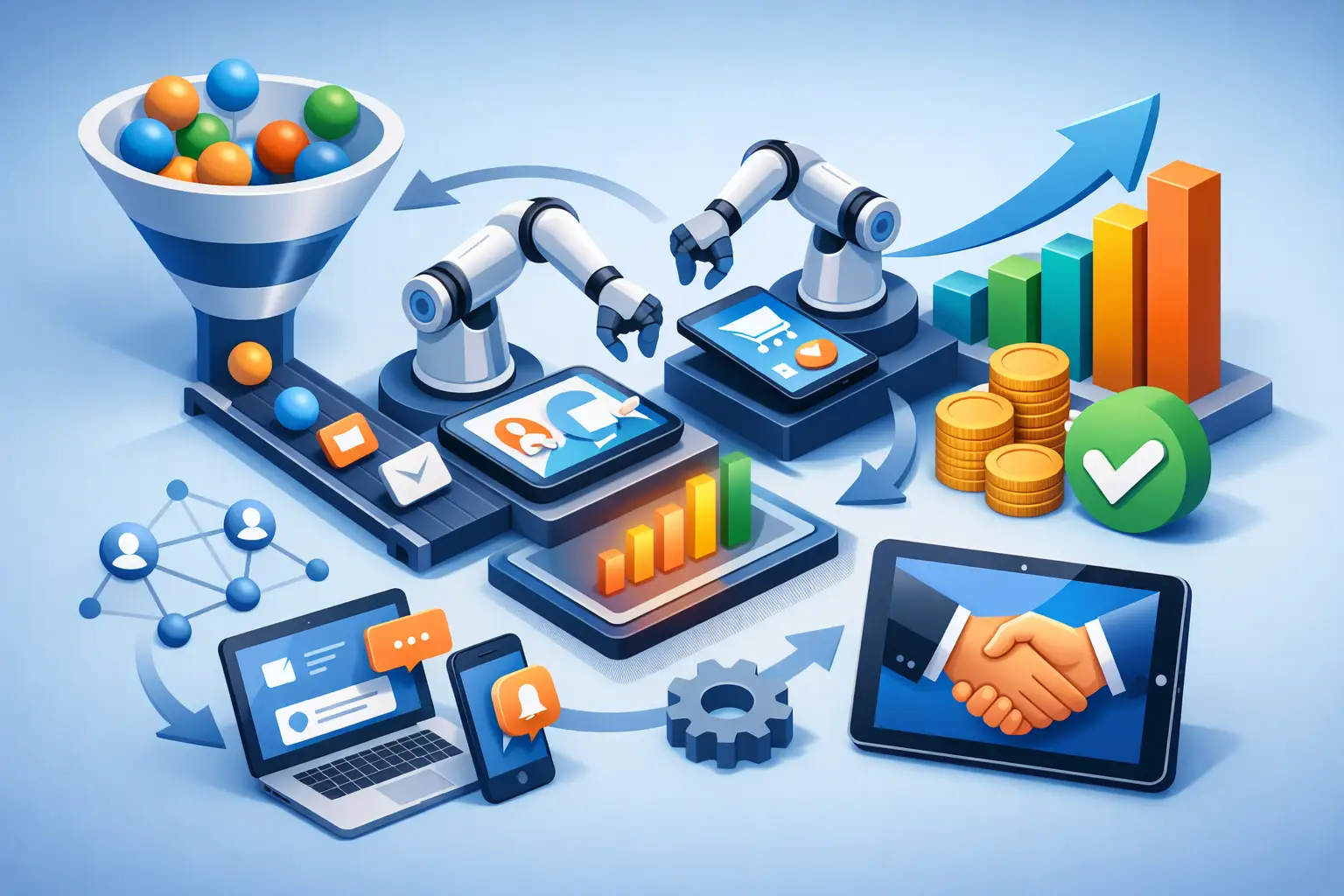
A Guide to Building a Sales Funnel with Full Control Over Your Leads

A lead who filled out a form and received no response for a full day is not just a forgotten task. It is a point of failure in the process that can turn into a lost opportunity, without anyone on the team seeing it in the reports. A guide to building a sales funnel should start exactly here: not with landing page design and not with choosing a flashy system, but with understanding how each inquiry comes in, who handles it, what happens next, and how the result is measured.
An effective sales funnel is a management infrastructure. It connects marketing, sales, price quotes, tasks, and follow-up, so the business stops relying on personal memory, scattered spreadsheets, or overloaded email inboxes. For a growing business, this is the way to gain control over the pace at which each opportunity progresses - and over the quality of the work that leads to a close.
What Is a Sales Funnel and What Is It Supposed to Solve
A sales funnel is a defined series of stages that a potential customer goes through, from the moment they show interest until they become a customer, and sometimes afterward as well. Each stage represents a clear business state: new lead, initial contact, discovery call, price quote, negotiation, win or loss.
The goal is not to create as many stages as possible. The goal is to represent the business's real buying process in a way that can be managed. If salespeople don't know what the next action is for a given lead, or if the business owner can't explain how many open proposals exist and what they are worth, the funnel is not providing control.
A good funnel solves four operational problems: it prevents inquiries from falling through the cracks, it defines ownership of every opportunity, it enables revenue forecasting, and it shows where the sales process gets stuck. This data is just as important as the close itself, because it lets you improve the system instead of guessing.
A Guide to Building a Sales Funnel: Start with the Existing Process
Before defining statuses in a CRM system or connecting automations, map out reality. Review the last 20 to 30 leads: where they came from, how long it took to respond to them, which conversations took place, when a proposal was sent, and what happened in the end. Such a review usually exposes gaps that aren't visible in day-to-day work - for example, a lead handed off without an owner, proposals that get no follow-up, or unsuitable inquiries that burden the team.
After mapping, define the funnel's entry point. A lead can come from a website form, a paid campaign, an incoming call, a social media message, a customer referral, or a meeting. It's important that every source be recorded uniformly. Without an accurate lead source, you can't know which marketing channels generate revenue and not just inquiry volume.
Next, define what qualifies as a lead worth handling. In service businesses, for example, you might require a minimum budget, geographic fit, a clear need, or decision-making authority. There's no need to disqualify every imperfect lead, but you should distinguish between an inquiry that requires immediate handling and one that deserves longer nurturing. Otherwise, the team invests valuable time in opportunities that are unlikely to progress.
Choose Stages That Drive Action
In most businesses, five to seven stages are enough. A practical example might include: new lead, contact made, qualified lead, discovery meeting, proposal sent, negotiation, closed won or closed lost.
Each stage should have one clear meaning. "In progress" is a weak status because it can include anything. By contrast, "first contact attempt" tells the team what happened, while "discovery meeting scheduled" lets you measure how many inquiries reached a quality conversation.
Also define transition conditions. A lead doesn't move to "qualified lead" just because someone spoke with them, but only after minimal information has been gathered about the need, the fit, and the next step. A proposal isn't "sent" until it has actually gone out to the customer and been recorded in the system. This discipline is what makes the report reliable.
Define Ownership, Response Times, and Next Action
The stage alone is not enough. Every opportunity must have an owner, a target time for the next action, and a short record of the context. Even a one-person business needs this structure, because it prevents decisions based on momentary workload.
Initial response time is a key metric. For hot inquiries, a response within minutes or hours can significantly change the conversion rate. For more complex inquiries, you can set up an automatic acknowledgment followed by an organized follow-up task. The difference is between automation that replaces human interaction and automation that ensures human interaction happens on time.
The next action should be concrete: a call on a specific day, sending a document, a reminder after a proposal, or a request for additional information. "Check back later" is not management. If there's no future action, the lead will usually remain in the funnel until someone decides to clean it out manually.
Connect Automation, but Don't Give Up Judgment
The right automation removes repetitive work and reduces errors. When a new lead comes in, you can create a contact, assign a source, allocate an owner by field or region, open a follow-up task, and send a confirmation message. When a meeting is scheduled, you can update the status, record the date, and create a reminder for the team.
Price quotes are also an important automation point. After a discovery call, a well-organized system can generate a task to prepare a proposal, save the documents under the right customer, and trigger a reminder if no response is received. This way the quote doesn't remain in a local file or an old message.
That said, not every decision should be automated. Lead scoring can help with prioritization by source, budget, field of activity, or engagement, but it is not a substitute for a professional conversation. In B2B businesses with complex deals, the quality of the need and the ability to influence a decision are sometimes more important than a technical score. Automation should route work, not pretend it fully understands the customer.
Measure the Funnel by Conversions, Speed, and Value
The monthly number of leads is a partial metric. To understand whether the funnel works, you need to measure the transition from stage to stage. How many new leads received a response? How many became meetings? How many meetings became proposals, and how many proposals closed?
Also check the time spent in each stage. If many proposals stay open for over 30 days, the price may not be the problem. Perhaps there's no follow-up process, perhaps the proposal is sent too early, or perhaps the customer didn't go through sufficient discovery before receiving it. Data like this leads to a precise operational question, and not just a general demand to "sell more."
Pipeline value is another metric: the sum of open deals, weighted by the likelihood of closing at each stage. It is not a guarantee of revenue, but it allows you to plan staffing, marketing budget, and sales targets based on information. The more consistent the definitions in the system, the more useful the forecast becomes.
Analyze Losses Without Hiding Them
Leads that closed unsuccessfully are not data waste. Define fixed loss reasons, such as budget, poor fit, choosing a competitor, timing, or no response. Don't create dozens of overly detailed reasons, because the team won't use them consistently.
After a few months, the loss reasons show whether the problem lies in lead quality, the value proposition, pricing, or the sales process. If a high percentage of inquiries are unsuitable to begin with, the solution may be a change in messaging and intake forms - not necessarily more sales training.
Proper Implementation Matters More Than Choosing the Tool
A good system won't fix a vague process. Before implementation, determine who updates statuses, which fields are mandatory, when a task is created, who receives an alert, and which report is reviewed once a week. These are management decisions, not just technical settings.
Start with a simple version that works: defined stages, lead source, owner, next action, and loss reason. Once the team uses it consistently, you can add scoring, dashboards, form integrations, proposal management, and advanced automations. Trying to build a perfect system on day one tends to delay adoption and create unreliable data.
It's worth holding a short weekly funnel review. Go over opportunities with no future action, old leads, and proposals that have been waiting a long time. The goal is not to monitor people, but to protect revenue from disorder.
A good sales funnel is not a one-time document. It is a management mechanism that must be updated as the buying process, the services, or the team structure change. When the system shows every person the next step and gives managers the full picture, growth stops depending on memory and luck.