A Guide to Digital Customer Journey Mapping That Creates Control
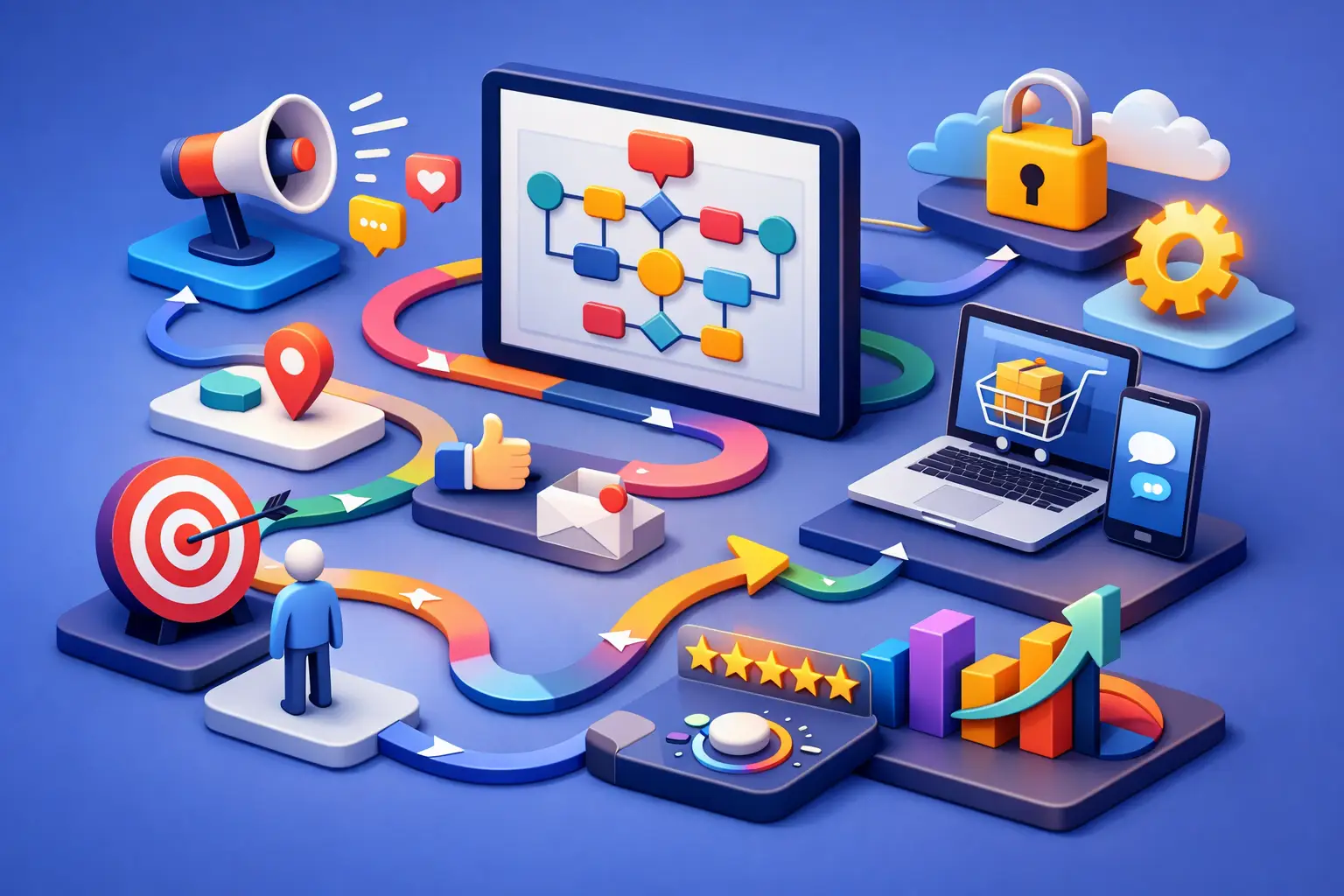
A customer left their details, received an automated message, spoke with a rep - and then disappeared. In most cases, this is not a motivation problem on the part of the salesperson, and not just a lead quality problem. It is a sign that the business does not see the full sequence of actions. A guide to digital customer journey mapping is meant to turn this sequence into a clear management system: who arrived, from which channel, what they were trying to achieve, what stopped them, and which action by the business can move them to the next stage.
Good mapping is not a nicely designed diagram for a presentation. It is the foundation for making decisions about campaigns, landing pages, response times, automations, price quotes, customer service, and performance reports. When every stage is documented and measured, you can stop guessing and start managing.
What Is Digital Customer Journey Mapping
A digital customer journey describes the process a person goes through from the moment they recognize a need until they become an active customer, and sometimes a repeat customer or a referrer. The process is not always linear. A customer might see an ad, visit the website, leave, search for the company name on Google, download professional material, leave their details, and only a week later respond to a message.
The mapping connects three layers. The first is customer behavior: searches, visits, clicks, inquiries, and responses. The second is the touchpoints the business operates: website, form, WhatsApp, email, sales call, price quote, and service system. The third is the operations layer: who is responsible, what information is stored, which action is triggered automatically, and what the success metric is at each point.
A business that measures only leads misses the picture. The campaign may generate many inquiries, but the form passes along partial information, there is no clear ownership assignment, response time is long, and reps send quotes without documenting the need. Customer journey mapping exposes the missing connections between marketing, sales, and operations.
Start with the Business Goal, Not the Tool
Before sketching stages, define the goal the mapping should improve. For a service business that sells complex projects, the goal might be increasing the rate of quality meetings or shortening the time from inquiry to price quote. For a business with an ongoing service, the goal might be improving the onboarding process and reducing churn in the first month.
A precise definition prevents mapping that is too broad. There is no need to map every screen, every message, and every exception on day one. It is better to choose one journey with a clear business impact, for example: a lead arrives from a campaign, goes through qualification, schedules a call, receives an offer, and progresses to signing.
It is also important to decide what counts as a conversion at each stage. Leaving details is a micro-conversion, but it is not necessarily a business success. A scheduled call, an opened quote, a closed deal, and a first payment are different events, and each one has a different operational meaning.
Define the Customer by Context and Intent
A generic persona like "small business owner" is not enough for managing a digital journey. You need to understand what situation they are in when they encounter the business. Are they looking for an immediate solution to a mess in their leads? Are they evaluating vendors for implementing a broad system? Have they already tried an automation tool and failed to connect it to the team and the data?
The same service can meet several different journeys. A customer who arrives from a referral usually needs proof of fit and an organized onboarding process. A customer who arrives from organic search may be in a learning stage and will need content that clarifies the problem, the costs, and the options. A customer who filled out a form following a campaign may expect a fast, focused response.
This distinction affects the message, the form, the follow-up series, and the way the team handles the lead. The goal is not to build dozens of scripts, but to identify the 2-3 paths that generate most of the revenue or operational load.
How to Build the Journey Map in Practice
Map Stages and Touchpoints
Write the journey from the customer's point of view, not from the point of view of the organization's departments. In most businesses, the path will include awareness of the need, research and evaluation of solutions, making contact, assessment or a diagnostic call, decision making, onboarding, and retention.
For each stage, document what the customer is trying to do, what they need to know, which channel they use, and what the business asks them to do. For example, at the contact stage, the customer wants to understand whether there is a basic fit. The business wants to collect enough details to route the inquiry correctly. If the form is too long, it creates friction. If it is too short, the team receives leads without context and has to complete information manually.
At every touchpoint, also mark ownership. Who handles the inquiry? Who checks that no quote is sent without approved pricing? Who follows up with a customer who did not open an email? Clear ownership turns the map into a working tool rather than a theoretical document.
Identify Friction, Information Gaps, and Delays
Friction is not just a technical glitch. It can be a marketing promise that does not match the landing page content, a form that is not mobile-friendly, a confirmation message that is too generic, or a gap between the response time the customer expects and what the team can deliver.
At each stage, examine three questions: what makes the customer move forward, what might make them stop, and what information is missing for the business to act correctly. Then check actual data. Page drop-off rate, lead source, initial response time, meeting scheduling rate, quote open rate, and closing time will show where the problem is, instead of relying on gut feelings.
Sometimes the most important metric is actually the dwell time between stages. If quality leads wait a full day for a response, improving the campaign will not solve the problem. If quotes are sent quickly but are not opened, it may be that the message in the sales call did not prepare the customer to receive them, or that the quote itself is too complex.
Connect Systems Without Creating Additional Load
A good map also shows the flow of information between systems. A lead who filled out a form should enter a central database with the inquiry source, contact details, area of interest, and status. From there, you can assign them to a team member, send a notification, trigger a follow-up message, and document every activity.
Automation is not a solution for every point in the journey. An immediate confirmation message, a meeting reminder, or lead assignment by criteria are excellent candidates for automation. On the other hand, diagnosing a complex need, handling an objection, or building a strategic proposal require human judgment. The goal is to reduce repetitive work and maintain consistency, not to turn every interaction into a cold template.
When adding AI to the process, clear boundaries must be defined: summarizing calls, classifying inquiries, drafting replies, or extracting insights can save time. Decisions about pricing, commitments to the customer, or changing a deal's status should include human oversight, especially in high-value deals.
Metrics That Turn Mapping into Ongoing Management
The map should be checked against a dashboard, not left in a file. Choose metrics that represent real progress in the journey: cost per quality lead, first response time, percentage of leads that received a response, inquiry-to-meeting conversion rate, quote-to-deal conversion rate, sales cycle length, and repeat customer rate.
There is no need to measure everything at the same level of detail. A business with hundreds of leads per month will gain value from segmentation by source, campaign, rep, and service type. A small business with a limited number of deals can gain more from a weekly review of every stalled deal and the reason for it. The level of measurement depends on volume, complexity, and the team's ability to act on the data.
It is worth setting a fixed review cadence. Once a month, you can examine trends across the entire path. Once a week, it is worth examining active bottlenecks: leads without owners, meetings that were not confirmed, quotes without follow-up, or customers who started an onboarding process and did not complete it.
Mistakes That Weaken the Mapping
The first mistake is mapping an ideal journey instead of reality. If in practice leads arrive through a salesperson's personal WhatsApp, quotes are sent from various files, and statuses are managed from memory, this must be documented. Only then can a feasible change be planned.
The second mistake is focusing only on the purchase. In many journeys, it is precisely the first days after the sale that determine whether the customer will experience value, stay over time, and recommend. An organized onboarding process, proper data collection, expectation alignment, and team alerts can be more significant than another sales message.
The third mistake is building a system that is too complex. If the team does not update statuses or does not understand what the next action is, the system will not create control. It is better to have a simple process with clear working rules, and then expand it based on data and need.
Digital Customer Journey Mapping as a Tool for Controlled Growth
The value of digital customer journey mapping is not only in improving the conversion rate. It allows the business to know where to add headcount, which actions are worth automating, what information the team is missing, and which channels bring high-value customers over time.
When marketing, sales, quotes, and service work on the same data sequence, fewer inquiries fall through the cracks and fewer decisions are made based on gut feeling. This is a shift from reactive work to organized management of the growth process.
Start with one journey where you currently have the most lost revenue, delays, or manual work. Map reality, set one metric for improvement, and build a clear operational action for each friction point. From there, you can expand the system without losing control.