2026 Business Automation Trends That Will Change How You Manage
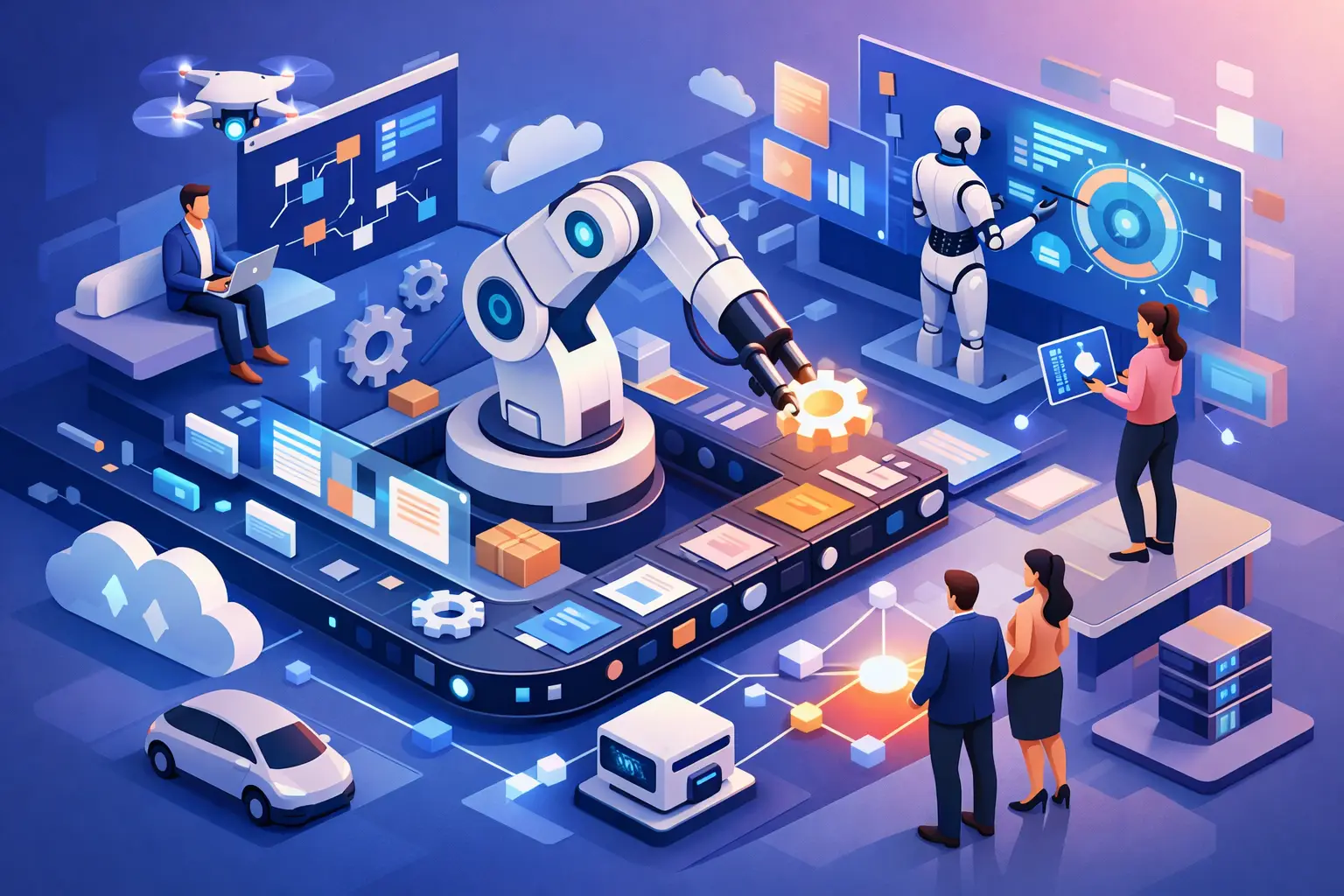
A business that handles new leads manually, copies data between systems, sends a quote from an old file, and only finds out at the end of the month what happened in sales - doesn't suffer from a lack of tools. It suffers from a lack of a business operating system. 2026 business automation trends point to a clear shift: organizations are no longer buying yet another app and are starting to connect processes, data, and decisions into a single workflow that can be measured and managed.
The technology alone is not the trend. The trend is the move from point automations to an operational infrastructure that reduces dependence on employees' memory, cuts repetitive actions, and lets management see what is moving forward, what is stuck, and what needs attention. For small and mid-sized businesses, this is the fundamental difference between growth that creates overload and growth that stays under control.
2026 Business Automation Trends: From Flow to Management Infrastructure
In recent years, it was relatively easy to set up an automation: a form fills out a spreadsheet, a chat message is sent, and a lead enters a CRM. In 2026, expectations are higher. The business needs to know who is responsible for the next step, what the handling status is, how much time has passed in each stage, and what happened to the customer afterward.
In other words, quality automation is not just passing information between two systems. It defines a process. It builds uniform statuses, sets escalation conditions, documents history, and presents a status overview to a manager or business owner. When the process is not defined, automation simply spreads confusion at a higher speed.
The practical implication is that successful projects start by mapping decision points: what triggers the process, what information is essential, who needs to be notified, when human intervention is required, and which metric proves the process works. This is less flashy than a chatbot, but it is the part that creates control over time.
AI Agents Move from Content Tasks to Controlled Execution
Artificial intelligence is no longer limited to drafting messages, summarizing meetings, or generating ideas. The prominent trend is the integration of AI agents into defined business processes. An agent can classify incoming inquiries, extract details from documents, prepare a draft quote, identify leads that haven't received a response, or surface exceptions to a manager that require a decision.
However, the value is not in running an autonomous agent without boundaries. In a real business, certain actions require approval, documentation, and access rules. For example, you can let AI prepare an initial reply to a customer, but not send an exceptional discount without approval. You can let it read an invoice and fill in fields, but not change financial data without verification.
The right model is a clear division of labor. AI handles scale, speed, and pattern recognition. People handle judgment, complex relationships, and high-impact decisions. Businesses that try to replace every human step may discover costly mistakes or inconsistent customer service. Businesses that build the right approval paths will gain acceleration without losing control.
Data Quality Comes Before Model Intelligence
AI will not fix on its own a system where every salesperson has a different definition of a hot lead, where duplicate customers appear in three places, or where deal status isn't updated. The more scattered and inconsistent the data, the less reliable the recommendations and automated actions will be.
That's why one of the most important investments in 2026 is data standardization: fixed fields, a single source of truth for each type of information, update rules, and duplicate removal. This is not marginal maintenance work. It is the foundation for accurate reports, stable automations, and decisions the system can support.
Lead Automation Is Measured by Handling Speed, Not Number of Forms
Leads are one of the places where loss of control quickly turns into lost revenue. A customer leaves their details, but the message sits in an email inbox. A salesperson receives the details without context. The quote is sent, but there is no follow-up task. In such a case, a lead system exists on paper, but there is no managed sales process.
The trend is building a full lead journey: capture from various sources, basic quality check, automatic assignment to a handler, an immediate confirmation message, a scheduled follow-up task, and documentation of every touchpoint. When a lead isn't handled within the set time, the system should surface the exception - not assume someone will remember.
That said, not every lead needs to go through the same path. An inquiry about a complex service sometimes requires a quick call with an expert, while an initial inquiry about a standard product can receive automated information before a call. Automation should reflect the level of intent, the customer's value, and the complexity of the sale, rather than apply a uniform template to every inquiry.
Quotes Become a Process with Status and Accountability
A quote is not a document that is sent and disappears. It is a critical stage that connects sales, pricing, approvals, and future operations. In 2026, more businesses are building a process in which a quote is generated from templates and CRM data, goes through approval according to defined conditions, is sent with tracking, and is updated automatically when the customer responds or approves.
The advantage is not only time savings. It reduces pricing errors, prevents the use of outdated versions, and makes it possible to understand what is really happening in the sales pipeline. If there are ten open quotes, management needs to know who sent them, when, what they're worth, and what the planned next action is for each one.
Dashboards Shift from After-the-Fact Reporting to Exception Management
Many businesses keep reports but don't use them to manage the day. An end-of-month report can tell you that sales were lower, but it doesn't prevent the problem in real time. The trend is a move to operational dashboards that display exceptions: leads without a response, delayed quotes, tasks left open, customers who haven't been renewed, and activities that aren't meeting targets.
The choice of metrics should be narrow and tied to action. The number of website visits may be interesting, but an operations manager also needs lead response time, conversion rate by source, average time to prepare a quote, and the number of blocked tasks. A good metric is one that leads to a clear question: who is handling this and what is the next step?
In a mature system, data also triggers action. When a deal sits idle, a task is created. When a customer crosses a certain usage threshold, an alert is sent to the team. When a lead source stops generating quality inquiries, the decision-maker sees it before the budget is wasted. This is where the important link between analytics and automation is created.
Security, Permissions, and Governance Become Part of the Design
As more systems are connected and more employees use AI tools, access permissions become more important. Good automation doesn't grant broad access to everyone who is logged into the system. It defines who can view, edit, approve, or export information - especially when it involves customer details, quotes, financial data, or sensitive commercial information.
Businesses also need to define ownership of each process. Who is responsible if a connection fails? Who checks that messages are sent as required? Who approves a change to a quote template or pricing terms? Without clear ownership, even an advanced system gradually becomes a black box that no one wants to touch.
It's important to avoid two extremes: a hasty setup without documentation, or a giant project that tries to organize the entire business before launching anything. The effective path is to build modular processes, document the key rules, and improve based on real usage. Start in an area where manual work or loss of tracking has a clear cost, measure the impact, and then expand.
How to Choose the First Move
The first move is not necessarily where the technology is most impressive. It's where there is a high volume of repetitive work, frequent errors, delays, or lack of transparency. For one business, it will be lead handling. For another, quote creation and follow-up. For a service team, it may be managing internal requests and passing information between parties.
Before implementation, it's worth defining a single business outcome: shortening response time, reducing leads that fall through the cracks, shortening quote preparation time, or improving management capability. Then build the process around the outcome, not around a particular tool. AIA implements systems of this kind with a broad view of leads, operations, analytics, and ongoing management, because one process almost always affects another.
The competitive advantage in 2026 will not go to whoever has the most AI tools. It will go to the business that knows how to define a process, keep data clean, set accountability, and turn information into timely action. Start with one process that is blocking growth today, give it an owner and a success metric, and build from it an infrastructure that lets the business operate in an orderly way even as activity grows.