AI Agents for Business: How to Build a System That Actually Gets Work Done
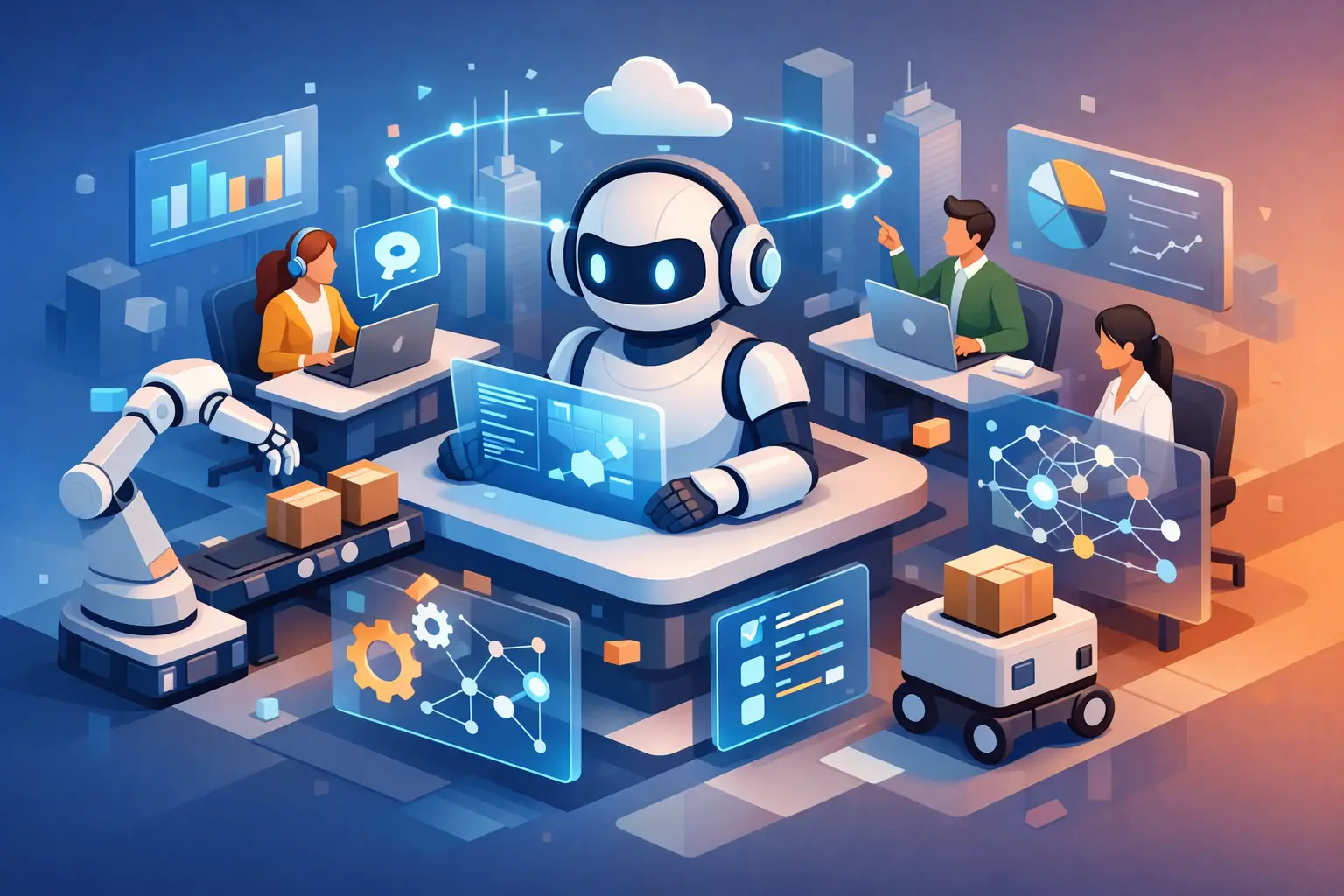
A lead comes in through a website form at 10:40 PM. By morning, it should already be classified, logged in the system, assigned to the right salesperson, and given an initial response tailored to the inquiry. If every one of those actions depends on an employee remembering to log into several systems and update data manually, the business loses time, consistency, and sometimes revenue. AI agents are designed to address exactly this gap: not just to draft text, but to carry out a sequence of business actions based on context, data, and defined rules.
The difference is substantial. A standard AI tool waits for a question and returns an answer. An AI agent receives a task, checks information in the relevant systems, decides on the next step within the framework it has been given, carries it out, and documents the result. It can identify a high-potential lead, request missing details, open a task, prepare a draft quote, and alert the responsible person when a human decision is required.
What AI Agents Actually Do in a Business
An agent is not a digital employee that replaces an entire department at the push of a button. Its value emerges when it is connected to a clear process: a trigger, information sources, permitted actions, stop conditions, and a person responsible for exceptions. That's why the right question isn't "Which agent is the smartest?" but "Which process is costing us time, errors, or control today?"
In lead management, for example, the agent can read the inquiry details, identify the type of service requested, compare the data against predefined qualification criteria, update the CRM, and route the inquiry. If the lead came from an existing customer, it can show the salesperson the history of communication and previous quotes. If the budget or timeline is missing, it can send an organized follow-up question instead of passing a partial inquiry between several people.
In the quoting process, an agent can collect data from a sales call, specification documents, and a pricing database, generate a draft based on an approved template, and flag items that require review. This is an important point: it can speed up quote preparation, but it doesn't necessarily need to be the one that approves an unusual price, payment terms, or a legal commitment.
There are also practical uses in internal operations. An agent can summarize meetings and assign tasks, check which tasks are left without an owner, compile data for a weekly report, identify project delays, and send a targeted alert. Instead of a manager collecting statuses from ten conversations and several spreadsheets, the information flows into a uniform structure that can be managed.
The Difference Between Automation and an AI Agent
Traditional automation follows a fixed rule: if X happens, do Y. It works well when the process is stable and the data is structured. For example, when a customer fills out a form, a record is created in the system and a confirmation message is sent. There's no need for a language model to perform this action.
An AI agent comes into play when interpretation is required. It can read a free-text message, understand whether it's a service request, a complaint, or a sales opportunity, and choose the appropriate path. It can extract information from an unstructured document, compare several sources, and draft the next action according to business guidelines.
In practice, the best systems combine the two. Automation handles the fixed, precise, repetitive actions. The agent handles the points involving free text, context, prioritization, or a need for a recommendation. This combination keeps costs reasonable and reduces the risk of inconsistent decisions.
Where to Start with AI Agents
The right start isn't a big project, but a single process with a clear workload. Look for a task that repeats often, involves moving information between systems, and where handling time or error rate is easy to measure. A process like this lets you prove value without disrupting core operations.
Lead intake is usually a good candidate, because it connects marketing, sales, and management. Generating meeting summaries, sorting service requests, updating statuses, and preparing reports can also be good starting points. By contrast, credit decisions, contractual commitments, or irreversible actions in a customer account require a higher level of control and are not good places to start.
Before defining the agent, you need to map the current state. Who triggers the process? Where does the information come from? In which system is it stored? What decisions are made along the way? What happens when information is missing or when the data contradicts itself? Mapping like this sometimes reveals a more basic problem: it's not AI that's missing, but uniform fields, ownership of tasks, or a central system for managing work.
Defining Action Boundaries
Every agent should be given a narrow, measurable area of responsibility. Instead of defining "manage the sales," it's better to define: "classify incoming leads, update the record, assign an owner by region and service, and send an opening message only after checking for duplicates." A definition like this makes it possible to check results and quickly identify when the agent deviates from expectations.
At the same time, you need to determine what it is not allowed to do. Can it send messages on behalf of the company? Is it allowed to change a deal status? Can it delete data? Which amounts, customers, or types of requests require human approval? Clear boundaries don't limit the system; they're what makes it a business tool you can rely on.
Connecting to the Right Data
A good agent doesn't compensate for scattered, unreliable data. If the customer status is in one spreadsheet, the inquiry history in an inbox, and the quotes in personal folders, it will get only a partial picture. That's why a professional implementation starts by defining a source of truth for each type of information: a CRM for leads, a task management system for projects, a document repository for quotes or procedures, and an analytics system for performance metrics.
The connection between sources must be controlled. Not every agent needs access to all company information, and certainly not to personal or financial information without a need. Role-based permissions, action logging, and separation between a test environment and a production environment are part of the infrastructure, not a technical add-on.
Measurement: Not How Many Messages Were Sent, but What Improved
Implementing an AI agent should be measured like any operational initiative. If the goal is lead handling, the metrics can be initial response time, rate of completed details, rate of correct assignment, and meetings scheduled. For quotes, you can measure preparation time, number of revisions, percentage of quotes sent on time, and close rate.
It's important to measure quality as well, not just speed. An agent that classifies inquiries quickly but routes them to the wrong person creates overload instead of saving it. At the start, it's worth sampling results weekly, comparing them to employees' decisions, and improving the guidelines, rules, and information sources.
Sometimes the right outcome isn't full automation. An agent might prepare 80% of the work and a person approves the final step. In many cases, this is a more efficient model than trying to remove people from the process entirely. Control stays where it creates value, and employees stop wasting time on copying, searching, and reminders.
Mistakes That Weaken the Project
The first mistake is starting with a tool instead of a process. Choosing a platform before defining a business problem usually leads to an impressive demo that never becomes part of the daily workflow. The second mistake is allowing the agent to operate without documentation. Every significant action should be recorded: what was received, what information a decision was based on, what was carried out, and who approved it in the case of an exception.
Another mistake is treating the agent as a one-time project. Business processes change, services are added, sales terms are updated, and people switch roles. The agent needs ongoing operational ownership, testing, and periodic improvement. Without that, even a good system starts working from assumptions that are no longer true.
Finally, there's no point in hiding the change from the team. Employees need to know what the agent does, what information it consumes, when they're required to step in, and how to report an error. When the agent is perceived as a tool that organizes work and reduces overload, adoption is faster and the information fed into the system improves.
AI agents are not a goal in themselves. They are an execution layer within an organized business system, one that connects leads, tasks, quotes, data, and accountability. Start with a process that hurts today, build rules and metrics for it, and let the technology prove itself in actions you can see, measure, and manage.